



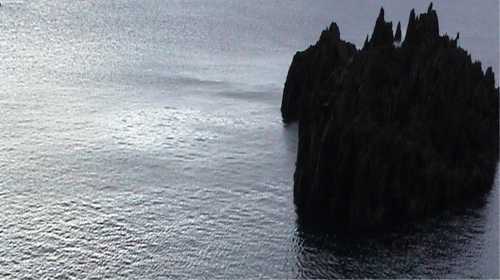
You can see the wind. Light winds make areas of "catspaw" ripples on the surface, stronger winds ruffle the surface so it looks dark, and very strong winds turn the surface white. You can see wind coming before it hits you.
Winds & the kayaker
When things go wrong for kayakers at sea, it's usually because of a little too much wind.
Sea kayaks cope very well with waves, tides, currents and extremes of temperature, but too much wind can be a real problem.
Over most of the Earth, most of the time, the wind is Force 1 or less on the Beaufort Scale. That's almost no wind at all.
However, a lot of the places that sea kayakers like best can get very windy indeed. That's because of global air circulation patterns and local weather, especially winter weather.
In Europe, sea kayakers in Britain, western France and Norway always take good care to check the weather forecast, look at the sky and think about escape routes before they set off round exposed parts of the coast. On the Atlantic coast, clouds and rain give a warning of strong winds. In the Mediterranean, fierce local winds from the mountains and desert often start under a clear sky. These winds include the Bora (off Croatia, sometimes strong enough to roll a car off its wheels and onto its roof!), the Meltemi (in the Aegean), the Mistral (south-east France), the Gregale (which wrecked St Paul's ship off Malta) and the Levanter (at Gibraltar).
Alaska can get seriously windy, and the coast of British Columbia is also a very windy place except where islands shield it from the ocean.
Chile, Tasmania, parts of southern Australia and most of New Zealand all have many days of strong wind because they are in the path of the Roaring Forties.
If the day of your trip is windy, you can avoid problems by changing your plans. Shorten the trip. Move it to a small estuary with wooded sides, or the downwind side of a headland. On a windy day, paddle upwind to start with so if anybody gets tired, the group will have an easy downwind ride back to where you parked your vehicles.
Light to moderate winds
0-3 Beaufort. Most sea kayaking is done in light to moderate winds, meaning wind speeds of less than 10 knots or Force 0-3 on the Beaufort Scale. A knot is one nautical mile per hour.
A moderate wind won't create big waves on its own, but if it blows in the opposite direction to a strong current it can quickly create a rough sea of steep waves ('wind over tide' conditions).
A moderate offshore wind (a wind that blows from the land out to sea) will make surf waves steeper, which may be a good thing if you're a keen surfer.
Stronger winds
Force 4 winds (11-16 knots) can create quite large waves if they blow continuously for a day or so. Even without the waves, Force 4 is too much for most learner kayakers. Kayakers seldom set off to sea when the wind is blowing 15 knots. It is sometimes said that a 15 knot wind blowing directly into your face (a headwind) will slow you down by 1 knot.
Force 5 winds (17-21 knots) are too much for many intermediate kayakers.
Force 6 winds. It has been calculated that a Force 6 headwind will slow you down by 1.5 knots.
Force 7 winds.
In a Force 7, any kayaker still at sea is probably in real trouble. When an "expert sea kayaker" says "Force 7, Force 8, no problem", just remember that most yachts, powerboats and even many commercial ferries are now tied up in the harbour.
For more about this, see Beaufort Scale For Kayakers.
If you are out kayaking and a strong wind is blowing right in your face, keep up the pace until you get to shelter. If you go slowly you will be out there struggling for a lot longer. If you stop for a rest you will drift backwards faster than you expect. A 10-minute rest on open water in a strong wind can cost you an extra 20 or 30 minutes paddling. See Leeway.
A strong wind can make kayaking on open water difficult or impossible, not so much because it pushes you to leeward as because it turns you off course. See Coping With Wind From The Side.
Also, wind creates waves. When a strong wind blows out to sea, the water may be smooth inshore but increasingly rough only fifty metres from the beach. And the further you go out to sea, the rougher the sea and the stronger the wind. An onshore wind blowing a long distance over water can create a heavy surf which makes things difficult or even dangerous. See Getting Back To The Beach.
A case history
This is from the Sennen Cove lifeboat log for 27 December 2006:
 "The Norman Salvesen launched at 11:20 this morning following a mayday call from a group of kayakers in trouble between Land`s End and the Longships lighthouse.
Initially the lifeboat had problems locating the kayaks due to poor visibility in flying spray and rough conditions...the lifeboat found one group of 3 kayaks with three people in the kayaks and one in the water clinging on. All four were recovered onto the lifeboat. A further kayak was then located with another person clinging onto it. Both the occupant and the person in the water were recovered. The remaining people were upright and OK in a double and two single kayaks.
"The Norman Salvesen launched at 11:20 this morning following a mayday call from a group of kayakers in trouble between Land`s End and the Longships lighthouse.
Initially the lifeboat had problems locating the kayaks due to poor visibility in flying spray and rough conditions...the lifeboat found one group of 3 kayaks with three people in the kayaks and one in the water clinging on. All four were recovered onto the lifeboat. A further kayak was then located with another person clinging onto it. Both the occupant and the person in the water were recovered. The remaining people were upright and OK in a double and two single kayaks.
Weather:- Overcast; wind southerly force 5-6; moderate sea, but rough and confused in the tide race off Lands End where the incident took place."
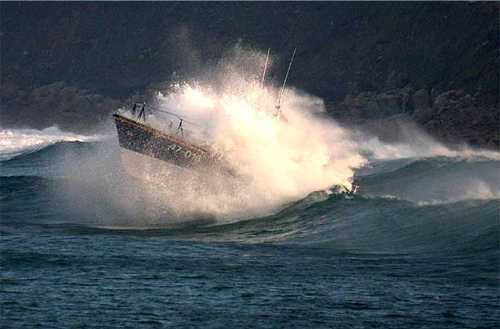
This terrific photo is the Norman Salvesen, all 14 metres and 26 tonnes of it, in big surf on a nice sunny day at Sennen Cove. It's a Tyne class steel lifeboat, and this image is courtesy of Tim Stevens from the lifeboat pages of his site at www.sennen-cove.com
The waters off Lands End are some of the most attractive but hazardous in Europe. The tide race, reefs and frequent large swell provide plenty of challenge, which is why we use them elsewhere for an example of How Not To Do It.
Add a force 5-6 wind and even a strong team of kayakers may be better off going for a beer instead. The rescue was a success in the sense that only one person required hospital treatment for hypothermia, only one kayak was lost, and the casualties got a cup of tea and a hot shower in the lifeboat station.
However the rescue required the time of 12 volunteer lifeboat crew, the launch of two big lifeboats from Sennen Cove and Penlee, the assistance of a commercial flight which diverted and circled the search area to help the emergency services find the casualties, the launch of an RAF Sea King helicopter from RNAS Culdrose, and "major incident" liaison by HM Coastguard's Maritime Rescue Co-Ordination Centre at Falmouth. Of course, everybody involved in this rescue would say "it's not about money, if you need help, call the emergency services straight away".
Northerly / southerly
English-speaking sailors, weather forecasters and navigators have a strange convention:
- "A northerly wind" comes from the north
- "A northerly current" goes towards the north.
In case you don't believe me: "The direction of winds is not designated, like that of marine currents, by the point of the compass to which they tend, but by the point from which they come; thus a northerly wind is directly contrary to a northerly current." That's a quote from A System of Universal Geography by M. Malte-Brun and James G. Percival (Boston, 1834). Thanks, lads.
Windward / leeward
Another sailor's convention is to see "leeward" instead of "downwind". It's usually pronounced "looard".
"A lee shore" is one towards which the wind blowing. If a lee shore has a wide expanse of open water to windward, it will be exposed to sizeable waves. If that open water is the ocean, there may at any time be oceanic groundswell surging over reefs and into caves. In windy conditions there will probably be a heavy surf on the beaches and waves exploding on the cliffs to send spray high into the air. A lee shore in a gale was a source of terror to the crews of old-time sailing ships, and may not be that much fun for a modern-day kayaker.
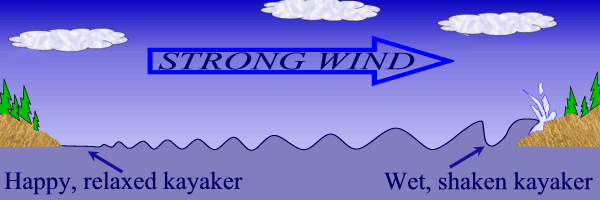
If you plan a trip along any exposed coastline of cliffs or steeply-sloping beaches, at a time of strong onshore winds you may not find many places where you can safely land for a rest. An island or headland may create a shelter from wind and waves. See The Effect of Landscape, below.
It's not just cliffs that make a dangerous lee shore for a kayaker. In the adventure novel Moonfleet, J Meade Faulkner describes the notorious Chesil Bank, which is a steep shingle beach 15 kilometres long on the south coast of England. During a southerly gale, a ship might go aground on the Bank only 20 metres from safety but none of the crew would ever reach it. The steep profile of the Bank causes waves to dump their energy violently and creates powerful undertow to drag a swimmer back out to sea. Even on a dead calm day, getting out of a kayak onto Chesil Beach calls for determination and good timing. On any other kind of day, one of the Bank's dumper waves can rip you out of your kayak, pull your wetsuit boots off and leave you covered in marks and bruises.
95% of the Atlantic coast of Europe is usually a lee shore, because the prevailing wind is from the west.
If an island is between you and the wind, it is "to windward" of you, and you are "in its lee" so it can protect you from strong winds. See The Effect of Landscape, below.
The causes of wind
Wind is created by pressure differences in the atmosphere. See The Origin Of Wind. You have only to look to windward to get a good idea what weather is coming. Dark clouds and rain usually mean strong winds. See Predicting The Weather.
The effect of landscape
Yacht and dinghy sailors know all about this, and kayakers need to be aware of it too.
Wind shadows and & turbulence
If you are "in the lee" of something like an island, a pier or a ship, then that object is sheltering you from the full force of the wind. They can all make a real hole in the wind, sometimes called a "wind shadow".
Where wind blows offshore, from the land to the sea, you will always find a wind shadow at water level. Have a look at the photo at the top of the page. The silver areas are smooth water. Even a low foreshore such as a beach backed by marsh will typically create a wind shadow extending ten metres out to sea. This means a continuous band along the beach with less wind and no waves, which makes a convenient avenue for kayakers on a windy day.
Where waters are sheltered by woodland there is a deeper wind shadow which may extend right across a lake. A cliff, building or even a single tree will create a wind shadow extending far downwind. In the lee of a large island, kayaking or sailing may be possible over a large area when winds generally are Force 6 or above. But if you venture past the final headland you may suddenly wish you hadn't. You may also get a surprise if you set off on flat water on a Force 4 or 5 day and paddle downwind across a channel a few kilometres wide, because that's wide enough on a windy day to create quite big waves crashing onto the downwind shore (lee shore).
On a day of strong offshore winds, you may be able to enjoy a relaxed sea kayak trip by staying in the wind shadow close to the base of a cliff. Note that there is turbulence round the edges of a wind shadow which may sometimes reach inside, so you may encounter strong gusts where river valleys reach the sea, and strong downdrafts where turbulence at the top edge of the cliff reaches down and touches the sea. You can see a gust coming, as a dark ruffled patch moving across the surface of the water, as in the photo at the top of the page.
It seldom requires any unusual attention, but on a windy day some cliffs generate powerful short-lived downdrafts called williwaws or rotors. Jim W, a highly experienced kayaker from Scotland, comments "I have never been knocked flat by downdraft as some older sea kayak texts and BCU syllabi say you will be, but that might be on account of my tenacity for staying upright. I have kayaked close in to cliffs on windy days and in my experience sometimes a downdraft can slow you to a crawl for a while. One memorable example was on the west of Skye where I went exploring close to some cliffs in the lee, and my friends stayed further out. I would estimate that although generally much calmer where I was, the downdrafts were possibly up to 2 Beaufort more than the gusts away from the cliffs, although estimating the wind speed of gusts is tricky."
Landscape features such as headlands and islands also affect waves and may create a useful wave shadow
Friction
Wind speed is reduced by friction with land. It is also reduced to a lesser extent by friction with the surface of the sea. In Sailing: Wind & Current (Adlard Coles, 1953) the naval architect and dinghy racer Ian Proctor says "the speed of the wind over the sea - or any large open stretch of water - is usually roughly double that over the land". One metre up, the wind is typically about half as strong as it is twenty metres higher.
Relief
Wind speed and direction are both affected by the shape of the land, otherwise known as relief or topography. This may create either problems or shelter for a sea kayaker.
Where wind encounters a trough in the landscape or a channel between island and mainland it is likely to change course and blow along it. The wind in a river valley always seems to be blowing either up or down the valley, never across it, and the effect is more powerful in a steep-sided valley like a fjord. This happens on a large scale in the St Lawrence River valley in Canada; in the Strait of Juan de Fuca between Vancouver Island and the USA; in the Columbia Gorge through the Cascade range which is a major location for American windsurfing; in the Cook Straits between the north and south islands of New Zealand, which is why they call it Windy Wellington; and in the Straits of Gibraltar between Europe and Africa, especially at Tarifa which draws windsurfers and kite-surfers from all over Europe.
An onshore wind which encounters a line of cliffs or mountain range may well change course to follow the line of the obstruction, and become more powerful and gusty.
Mountains also create differences of temperature, humidity and air pressure that can affect the sea downwind of them. See The Origin Of Wind.
| Go to next page for: • Beaufort Scale For Kayakers • Leeway |
 |
 |
 |