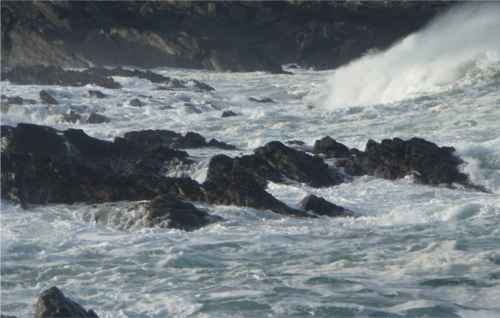
The first two pictures on this page are courtesy of Murty Campbell and Stornoway Canoe Club.
 |
Introduction
In some countries, it is a criminal offence to go sea kayaking without carrying distress signals. See Legal Requirements For Sea Kayaking.
Beware the talisman effect. On the road, people who feel safe because they're wearing a seat-belt or crash helmet are more likely to have an accident. A sea kayaker who has flares or an EPIRB or a VHF radio is more likely to push the limits. Calling for help does not always result in your being rescued promptly, or at all. Kayaking groups should be able to sort out most of their own problems. See Rafting-Up & Towing; Deep-Water Rescue & Self-Rescue; Repairs & Repair Kits; and First Aid Kits.
If you send up flares or trigger an EPIRB, somebody may come to help you but you won't know whether they're coming. If you have a VHF radio or mobile phone you can tell somebody where you are and what help you need, and you know that somebody is coming to help.
Let's say that your trip has just gone very wrong, so wrong that you can't get your group to safety. Before you set off you left details of your trip with a friend. Nobody will really worry about you until well after dark, which is probably too late for the Coastguard to co-ordinate an effective search. In a wilderness area it may be several days before a search begins. Can you speed it up?
VHF radio
A VHF radio is the best way of communicating at sea. It has all sorts of advantages over a mobile phone, particularly if there is an emergency.
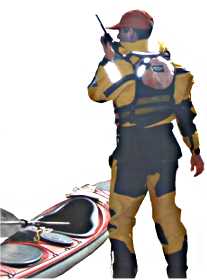 Do you need a radio?
Some sea kayakers would say "never go afloat without one" but that might be going a bit far. I agree that you need one if you lead groups of inexperienced or young sea kayakers, or if you paddle in an area where you are required to liaise with a port or military authority. They can also be useful for advanced day trips and expeditions.
As a sea kayaker, you can use a VHF radio to:
• Get the permission of port control to enter, cross or leave a major harbour (naval or commercial)
• Pick up maritime weather broadcasts
• Tell the Coastguard that you have set off from A intending to go to B and will call again on arriving safely
• Tell the Coastguard you are OK if you hear somebody wrongly report that you are missing or in trouble.
• Receive a message telling you that you are approaching a military exclusion zone or shipping lane
• Send a distress message
• Enable a lifeboat to pinpoint your position by radio direction finding (RDF or just DF)
A VHF radio is a bit of a nuisance. You have to buy it, licence it, charge it, carry it, do a radio check to see if still works, listen to it, remember how to talk with it, keep it dry, not drop it, sit on it, lose it or let it re-magnetise your compass, and occasionally carry out battery maintenance.
On the other hand, a good handheld VHF radio is not all that expensive. You want a small waterproof model with at least 4 watts output power and preferably 6 watts. A basic handheld model in 2013 will cost you £110 but it’s worth paying £230-odd to get one that has GPS and DSC. Manufacturers with good reputations include Standard Horizon (Yaesu) and Icom. Both offer handheld radios with 5 watts output power which float if you drop them.
Even with a "waterproof" radio it's good to have some way to keep it dry, such as a small transparent dry bag. It is best to carry a VHF radio somewhere you can easily reach it without sinking your kayak, ideally in the pocket of your buoyancy aid so you still have it if you are unlucky enough to lose your kayak. Alternatively in a deck bag, not somewhere which will require you to take off a hatch cover or your spraydeck.
You can get both radio and dry bag from a good kayak shop or yacht chandler. If you look for a cheap deal on eBay make sure your radio was made for use in your area. Radios manufactured for use in the USA / Canada are cheaper but they use different channels to those in the UK / Europe. For the UK you certainly want Channel 16 (distress, safety & calling), Channel 67 (the UK Small Ship Safety channel) and the usual working channels (6, 8, 72 and 77). It’s very useful to have Channels 23, 84 and 86 for HM Coastguard's maritime safety information broadcasts, Channel 12 (port operations), Channel 13 (navigational safety discussion between ships) and Channel 80 (marinas). There’s a complete list here: http://en.wikipedia.org/wiki/VHF_Marine_Radio. Your radio MUST NOT be able to transmit voice messages on Channel 70.
When not transmitting, most VHF radio users leave their radios on "dual watch" or “tri watch” so that they hear messages on their usual working channel and also on Channel 16.
Using a VHF radio
Marine VHF radios don’t allow the user to tune them like an ordinary radio. They are preset to give push-button access to a number of “channels”. A handheld VHF radio might give you 12 channels including the most important international channel, Channel 16.
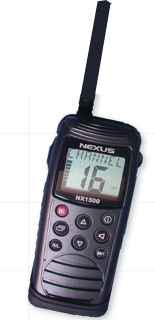 A VHF radio looks like a big mobile phone but it sends a voice message which can be picked up by anybody within range. Some radio signals will travel over the horizon, or right round the world, but we'll be using marine VHF radio for which the maximum range is “line of sight”. If you have a powerful VHF radio and you transmit while standing on top of an island 100 metres high, your message can be heard by anybody within a radius of 20 or 30 nautical miles, so this is not a private communications channel.
The maximum range is limited by the power of your particular radio. In Britain, the maximum permitted power for a VHF radio is 25 watts in high power mode, but you will get that much power only with a fixed radio that’s permanently mounted on a yacht or ship, with an external aerial on top of a mast, supplied with electricity from a big external battery. Handheld radios usually have a maximum power of 3 to 6 watts. (For comparison, a mobile phone may transmit at 3 watts.)
If you are sitting in a kayak, your line of sight to the horizon is less than 2 nautical miles. You probably won’t be able to talk to another kayaker further than that, and if there is a big swell running you may be unable to talk to another kayaker just a few hundred metres away. However that is not the maximum effective range of your VHF radio, because a yacht, ship or coastal radio station will have its aerial mounted on a mast as high as possible above water level. The aerial may be in line of sight even if the ship itself is invisible, hull-down beyond the horizon. See Distance To Horizon.
If you are transmitting from a kayak at sea level, using a 6 watt handheld radio set to "high power" and with a well-charged battery, your message may be picked up by a ship as much as 5 miles away. It may be picked up by a coastal radio station 6 or 7 miles away. 50 miles is occasionally possible in some atmospheric conditions. If you don't get a response to your radio message, kayak to a different location, or land on a beach and climb a hill.
If you have a radio which can produce the legal maximum 25 watts transmission, you could stand on top of a 100-metre high island, select “high power” and use the “press to talk” button to wipe out every conversation on that particular channel over more than 100 square miles. Because of this, people who use VHF radio are required to undergo training during which they are told:
- not to use high power mode unnecessarily
- to keep messages as short as possible
- to transmit as little as possible in a harbour or a busy estuary
- not to transmit foul language, music or chat about football
- not to talk to anybody on shore other than licensed shore stations
- not to use inappropriate channels such as those reserved for port operations, ship movements, search & rescue or Digital Selective Calling
- not to transmit accidentally. If you press the “press to talk” button while trying to find a Snickers bar in your pocket, you can jam the distress channel for miles around.
Mainly, VHF radio training tells you to keep your messages as short as possible. It’s not “Oh James, this is Johnny here again, old chap, sorry, this is James Grey I want to talk to on that nice yacht, now James I didn't quite catch everything you said, I wonder if you could repeat the last thing, after you told us where you were? Hello? Oh, sorry, over” it’s “Bluenose, this is Dyarchy, say again all after your position, over”.
You use standard words, and as few of those as possible. Even “please” and “thank you” are discouraged. Despite this, in busy yachting areas like the Solent it can be difficult to get a word in edgeways at the weekend. When there’s a bad storm in which a lot of different boats need rescue, as during the notorious Fastnet race disaster, it may be that most of the VHF channels are closed except for communications about particular rescues.
VHF training
To use a VHF radio around the coast of Europe you will need :
- a radio, obviously
- a Ship Radio Licence or Ship Portable Radio Licence. For a marine VHF radio, Ofcom deals with the licence. This is like a car registration document because it says who owns it and where it is kept.
- a qualification. You need a Short Range Certificate or SRC. It's like a car driving licence because it says that you know how to use a VHF radio. The Royal Yachting Association (RYA) deals with this in the UK. It’s a minor criminal offence to use a VHF radio unless you have a certificate, but getting an SRC certificate also has real advantages for you personally.
The SRC training plus assessment are currently included in a single one-day course. In 2013 prices ranged from £70 at a sailing club or college of further education up to £120 if you prefer being ripped off. Normally this sort of tuition is an “exempt supply” for VAT purposes but some trainers do charge VAT. You also have to pay £30 for the RYA’s fee. The training system may soon get a lot more disruptive and expensive because the Swiss, that great maritime nation, have been agitating to have it made into a two-day course.
Some trainers make it a half-day course and try to get through the entire syllabus plus exam in three hours. It’s a good idea to read up beforehand. The RYA produces two useful short publications "RYA VHF Radio (including GMDSS)" and "VHF Radio - Short Range Certificate - syllabus & sample exam questions". Order online from www.rya.org.uk
Alternatively there are some free online courses. They can't do the RYA assessment, but they can give you all the training. I really like this one from Spinaker Yachting: www.egmdss.com/en/. Spinaker are based in Slovenia but their English is very good, and the course is aimed at users everywhere in Europe. There are two things they talk about which don’t apply in the UK: When we say numbers on VHF radio we don’t use the nada zero, una one, bisso two, terra three, karte four, panta five, sox six, sette seven, octo eight, nove nine system, we just say one, two, three although there are special rules for pronouncing four and nine; and our Coast Radio Stations were closed down some time ago. Their job is now done by centralised radio stations at the Maritime Rescue Co-Ordination Centres.
Digital Selective Calling
You can now buy a handheld VHF radio which has GPS (Global Positioning System) and DSC (Digital Selective Calling). The general idea of DSC is that you can send a burst transmission lasting a fraction of a second which will be received by only one particular radio, or a particular group of radios. It's also possible to send a DSC message to everybody within range. Burst transmission is just our name for it, it's not an official expression. You can’t put much information into your burst, so it’s usually just a “heads up” to say that you’re about to send a voice message. There are four categories of message you can send with a radio - routine, safety (SÉCURITÉ), urgency (PAN PAN) or distress (MAYDAY). A routine message could be a DSC burst sent to your friend to say you want to speak to him/her on Channel 77.
GPS runs your battery down a little faster, but it means that the radio knows its own exact location. Digital Selective Calling enables you to send that location as a MAYDAY transmission by pressing the big red button for 5 seconds. It could save your life. DSC is part of the GMDSS (Global Maritime Distress & Safety System). To make the system work, each marine VHF radio with DSC must be registered to a particular vessel and given an individual 9-digit number which is a bit like a telephone number. For example, 235123456. This is the MMSI, which stands for Maritime Mobile Service Identity. If you sell the radio or the vessel, you have to go to the Ofcom licensing website and change the details for that radio, and the radio itself has to go back to a main dealer to have its MMSI number changed.
If you have registered your details under HM Coastguard Safety Identification Scheme CG66 the MMSI lets them find out exactly who you are, the size and colour of your boat, and the phone number(s) to contact your family. CG66 is free and you can do it online. Remember to update your CG66 information at least every two years.
Each marine VHF radio with DSC should also have a GPS function or be connected (interfaced) to a GPS unit, because then it will send not only the identity of your boat but also its exact location. If your radio doesn't have GPS, all it can send will be your MMSI number unless you manually typed in your latitude and longitude. The problem without GPS is that you may have typed it in wrongly, or you may have typed it in some time in the past so it sends the rescue services to where you were last Tuesday.
If you send a distress message using DSC you can also select the nature of the emergency from a short list (sinking, fire/explosion, piracy, etc).
When a radio receives a DSC message intended for it, it will beep to alert the owner. If any DSC radio receives a MAYDAY message it will set off an alarm loud enough to wake the dead.
Careless use of the DSC system can waste a lot of coastguard time and resources, which is why handheld radios with DSC are still illegal in many European countries, or illegal unless you have the national licence for that country. Recreational boaters in the USA can use a portable VHF marine radio without having any training. The result, according to the United States Coast Guard in 2012, is that "approximately 90% of VHF DSC distress alerts received by the Coast Guard do not contain position information, and approximately 60% do not contain a registered identity".
The DSC system has its own frequency, Channel 70, which is only for short digital burst transmissions. It’s a criminal offence to use it for voice transmissions. That’s not a problem if everybody uses a marine VHF radio, because if you try to talk on Channel 70, a proper marine radio will just make a rude noise and not transmit anything.
Comms within the group
If your group is taking two or more VHF radios you can agree in advance which of the ship-to-ship (intership) channels you will use as a working channel for communications within the group. In Europe that will probably be one of Channel 6, 8, 72 or 77. In the USA, probably Channel 68, 69, 71, 72 or 78. In Canada either Channel 72 or one specified for use in a particular region. Again, you will find a list at http://en.wikipedia.org/wiki/VHF_Marine_Radio.
Radio safety traffic
If you have "safety traffic", in other words you need to ask or tell something relevant to safety at sea, in the UK you can call:
- the Coastguard on Channel 16
- National Coastwatch on Channel 65.
As far as possible, get your information before you go afloat, from tide tables, charts, a tidal stream atlas, the weather forecast, and of course Google for things like supermarket locations, opening hours, taxi services, etc. However if you really need a weather forecast or other local information (well, maybe not taxi services...) this would count as legitimate "safety traffic" for the Coastguard or National Coastwatch.
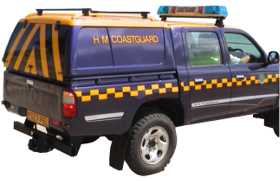 HM Coastguard. VHF Channel 16 is the maritime distress, safety & calling channel. It is the only voice channel constantly monitored by all Coastguard stations. It is essential that it does not get overloaded. Anybody using it must keep their message as short as possible. The first thing the Coastguard will do when responding to a call on Channel 16 is direct you to switch to another channel.
In your own home waters you may know that the Coastguard also monitors a channel other than Channel 16, in which case you should use that channel for non-urgent communication. For example, in the USA Channel 9 has been designated as the Boater Calling Channel for dual watch and hailing, so Channel 16 can be left for emergency use.
In Britain, HM Coastguard encourages kayakers to use VHF to notify them that they are going by kayak from point A to point B and again on safe arrival at B.
Natilonal Coastwatch. Maybe call up NCI before you call the Coastguard. HM Coastguard has support from volunteers, but it's a government agency. National Coastwatch, on the other hand, is entirely staffed by volunteers who keep a visual watch and radio watch along UK shores. The NCI undertakes activities in areas of the United Kingdom where the coastguard no longer operates. My thanks to Mike for this 2016 update: "Round most of the UK coastline it is now possible to call up the National Coastwatch Institution (NCI) on Channel 65 for ... local info. The NCI was granted this channel as its own information frequency last year, and already has over 60% of its volunteer watch keepers trained up to provide local information to sailors, walkers, fishermen, kayakers etc."
Making a call
As mentioned above, you need to undergo training and get a licence to use a VHF radio, but this is basically how you send a message.
Turn on your VHF radio, turn the power setting to "low" if you are within easy sight of the person to whom you want to speak or "high" if they are miles away, turn up the volume, turn up the squelch filter until the radio makes a nasty hissing noise and then turn it down until the hissing stops, and select a channel. Listen to make sure it is not in use. Then press the "transmit" or "press to speak" button and say into the microphone something like:
"Portland Coastguard, Portland Coastguard, this is Kayak Group Alpha, Kayak Group Alpha, I have safety traffic, over".
The word "over" means you want a reply. "Out" means that you are ending the discussion. "Over and out" is meaningless. Now take your thumb off the "transmit" button and listen for a response. If you don't get an immediate response you must, except in case of distress, wait at least two minutes before repeating the call.
The Coastguard will respond on Channel 16 telling you to switch immediately to another channel, so the response to your message might be:
"Kayak Group Alpha - Portland Coastguard - reply Channel 67".
International radiotelephony phonetic alphabet
If you have to spell anything, ideally you would use the NATO phonetic alphabet as follows:
Alpha Bravo Charlie Delta Echo Foxtrot Golf Hotel India Juliette Kilo Lima Mike November Oscar Papa Quebec Romeo Sierra Tango Uniform Victor Whisky X-Ray Yankee Zulu
Radio distress calls
 If you are in grave and imminent danger and require immediate assistance you are entitled to use a VHF radio to make a Mayday call.
If your radio has a DSC function you can send a MAYDAY burst transmission to all ships and radio stations within range, telling them your identity, position, time and the category of emergency.
You can also make a voice transmission to say where you are, what the emergency is, and how many people need help. Select the "high power" setting before transmitting. Hold the radio with the aerial vertical and as high up as possible. The signal's range and power will be greatly reduced if the aerial is not vertical.
The wording for a distress call is something like:
"MAYDAY MAYDAY MAYDAY.
This is Kayak Group Alpha, Kayak Group Alpha, Kayak Group Alpha, MMSI number 235123456 reporting a medical emergency.
MAYDAY
This is Kayak Group Alpha.
We are two seven zero magnetic from Ardnamurchan Point two miles.
We are a group of seven kayaks, red and yellow in colour. We have a kayaker suffering a severe asthma attack. The casualty requires immediate evacuation to hospital by helicopter.
Over."
It would be just as good to say "we are two miles west of Ardnamurchan Point". If you don't get an immediate response to a MAYDAY call, wait for one minute (UK) or 10 seconds (US) before repeating it.
Battery management
Most handheld VHF radios have Ni-Cad (nickel-cadmium) or NiMH (nickel metal hydride) batteries. According to radio manufacturer Icom, the dreaded "memory effect" has been almost eliminated from new batteries. However improper charging / discharging can still lead to the growth of crystals within the battery which will reduce its performance. You can expect 45% of batteries to fail within 12 months if improperly managed.
That figure can be reduced to 15% if you take care. On their expert pages Icom advise fully discharging the battery "to less than 0.6V per cell. This is best achieved by using a battery analyser, designed specifically to cycle the battery correctly". Second best is to leave the radio on until the battery goes flat. NiCd and NiMH batteries "should be cycled periodically to maintain the best performance. This process is sometimes referred to as conditioning. Some manufacturers provide fast chargers that discharge the battery before charging. Although this will prevent crystal degradation, the disadvantage is that the battery life could be reduced. This is because each battery cell has a finite lifetime in cycle terms and conditioning the battery each time uses one of these ‘lives’. To achieve optimum performance NiCd batteries that are in regular use should be conditioned once a month, whilst NiMH batteries need conditioning just once every three months".
Waterproof?
Icom's expert pages advise that even if a waterproof VHF is designed to survive spending 30 minutes underwater, to a depth of (say) 1 metre, if it gets splashed or dunked you should carry out maintenance. "Good practice is to rinse the radio with tap water and dry thoroughly... as salt can cause serious corrosion. After repeated exposure to spray all battery contacts should be inspected, cleaned and lightly greased. Knobs should also be removed and control shafts cleaned and re-greased likewise. After any exposure to moisture the radio should be thoroughly dried."