



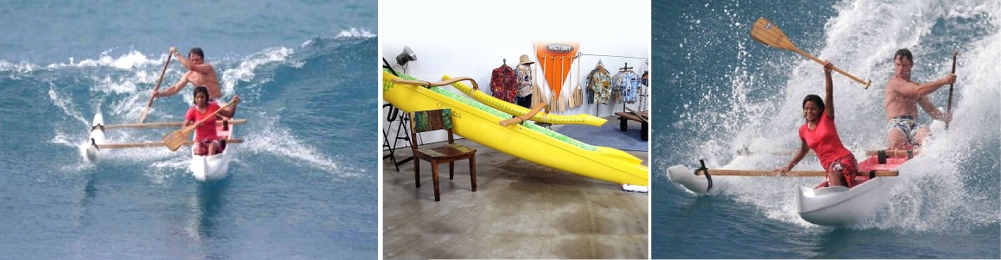
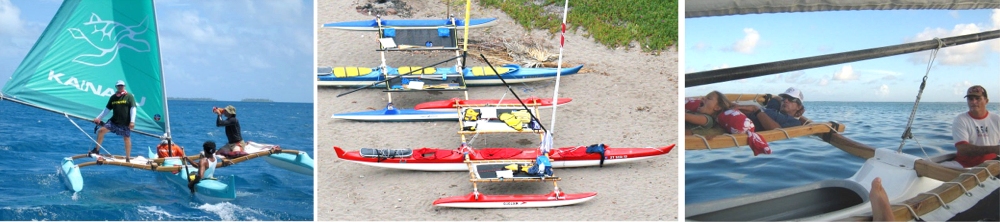
Photos: JC Bosson/DDB Strat / www.trykauai.com / Hawaiian Canoe Racing Association
Why outrigger canoes? Because they're as fast and seaworthy as a good sea kayak, but you can just climb in and go.
Outrigger canoes vs. sea kayaks
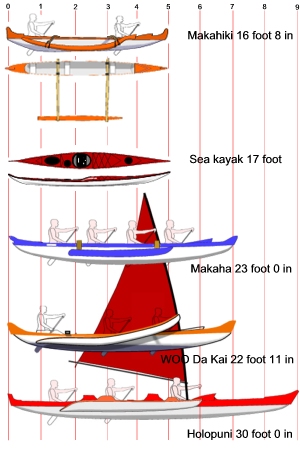
Comparing a 17-foot sea kayak with a 17-foot Hawaiian outrigger canoe:
| Hawaii isn't all ice cream and palm trees; it gets oceanic wind and waves | ... like where I live in the Hebrides, off the west coast of Scotland. |
| Sea kayaks and outrigger canoes are adventurous, attractive, seaworthy ... | ... silent, good for low-impact exercise, and environmentally friendly. |
| You can carry 2 sea kayaks or 2 outrigger canoes on a car roofrack | ... but an outrigger canoe takes 30 minutes and two people to launch. |
| Like a sea kayak, an outrigger canoe can launch from shallow water | ... but at 6-11 feet wide, an outrigger canoe won't slip through a slim gap. |
| A decked outrigger canoe gives paddlers as much shelter as a kayak | ... or even more, having a slightly higher sitting position. |
| Outrigger canoes are potentially faster and have a longer range | ... but they are heavier and more expensive than a kayak. |
| The outrigger canoe can carry 2 adults PLUS dogs or children | ... but an outrigger canoe usually needs two paddlers. |
| Outrigger canoes don't easily turn upside down (capsize)... | ... and if they do turn over, it's easy to turn them right way up again. |
| Outrigger canoes don't require 'upside down' skills | ... just basic sea/weather skills and common sense. |
| Outrigger canoes are safe for beginners and activity centres | ... but you can't rent somebody a sea kayak unless you go with them. |
| Outrigger canoes make good platforms for fishing and swimming | ... you can stand up, walk around, sunbathe or snooze. |
Classic sea kayaks are just about the perfect boat for individuals to explore the coast; in fact, that's the whole point of this website! They're beautiful, fast and very safe. And they keep you dry and warm, which is important if you paddle on cold waters. But you do need some upside-down skills to use them: That means good support strokes to stay upright, and an every-time roll so you can come straight back up after a capsize. Not every paddler will have those skills.
Some people choose to paddle a fast sit-on-top kayak or surf ski because they have the beauty and the speed, but if you fall off you can just climb back on again. However they're not ideal for paddling on cold waters as the paddler has a constantly wet backside and legs.
That's why I was keen to try a Hawaiian outrigger canoe. The nearest manufacturers were a thousand miles away, on the other side of the English Channel, so I built a rough 16-footer from plywood. It wasn't pretty, but it performed very well indeed. I tried it paddling and sailing, on my own and with a second paddler, in a wide range of sea and wind conditions.
Conclusion: Want!!
I definitely wanted a pretty Hawaiian outrigger paddling-sailing canoe for myself, and I realised they'd be great for hire fleets and guided operations on the west coast of Scotland.
Pacific outrigger canoes, or va'a
Modern va'a come in lots of styles, widths and lengths, for everybody from sprint racers to surfers, sailors both fast and slow, and people who want to go out for the day with a friend and the dog.
The Tahitian type is for sheltered lagoons, but the Hawaiian type is designed for use on the open ocean.
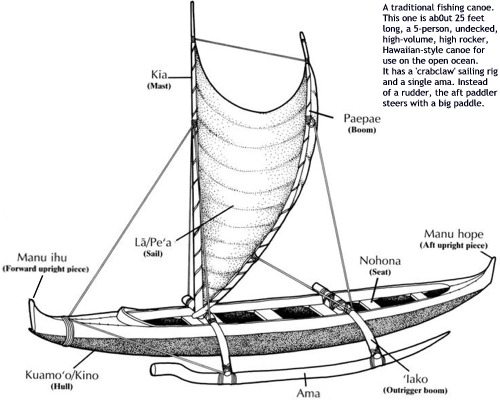
Hawaiian-style va'a are from 16 to 30 feet long, sometimes even 40 feet, and for 1 to 6 paddlers.
The main hull of a va'a is only about 46 cm (18 inches) wide where even a skinny sea kayak is likely to be 52 cm (21 inches) wide. The va'a hull would just fall over without an outrigger float (ama) off to one side to keep it upright. Traditional Hawaiian canoes have a single ama, for paddling and some sailing. For use on cold water with gusty winds, they can have an ama on each side. Then it's a little trimaran, which can be sailed while sitting in and facing forwards. And it still paddles easily.
Hawaiian outrigger canoes compared to sea kayaks
Let's take a closer look at these comparison points:
• Sea kayaks and outrigger canoes are both seaworthy. The kayak evolved in Greenland with cold seas, tide races and windy conditions, and in skilled hands, the right kayak can go practically anywhere, including big surf. In this part of the world, "anywhere" includes fast-flowing, rough and remote coastal waters such as the Grey Dogs, the Falls of Lora, the Dorus Mor, Tobermory to Ardnamurchan lighthouse, Caliach Point to Coll, Calgary to the Treshnish Isles, etc. Further afield it includes The B-tches, Skookumchuck and many more playspots.
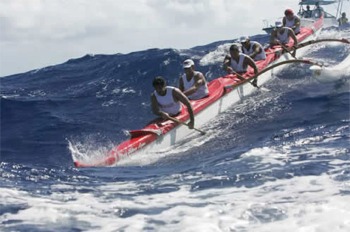 • The Hawaiian outrigger canoe evolved in a windy place too, and with bigger waves. A lot of va'a are designed for surfing.
• The va'a is heavier than a kayak and requires some assembly on the beach, but it moves through the water with similar or less resistance. With two paddlers, it is faster than a classic sea kayak.
• Being stabilised by one or two outrigger floats, the va'a main hull needs to be only 18 inches wide, compared with the 20-23 inches that a sea kayak needs for stability.
• You can carry 2 sea kayaks or 2 disassembled va'a on a car roofrack.
• A kayak paddler or the two paddlers of a va'a can carry their boat up and down the beach without a trolley.
• You can launch and land a kayak or a va'a through breaking waves, and they both give a fairly dry ride at sea.
• They both cope well with windy conditions and big waves, as long as the va'a has two paddlers.
• The va'a sits higher in the water and has more to catch the wind, so it needs two paddlers except in very light winds.
• That's a limitation (maybe you prefer solo paddling?). On the other hand, a pair of inexperienced teenagers can move a va'a faster and further than a strong paddler can move a classic sea kayak.
• Although slimmer, the va'a is much more of a boat. You can take the dog and a child or two. You can change position, have a stretch, even stand up. With the 'open boat' layout of the traditional undecked va'a, you can walk from one end to the other.
• The cool-climate alternative to an open va'a is a kayak-style deck with three cockpits (the middle one is one for storage and passengers).
• Just as with a sea kayak, paddlers in a va'a with cockpits, spraydecks and proper clothing can stay warm and dry even in January in Scotland.
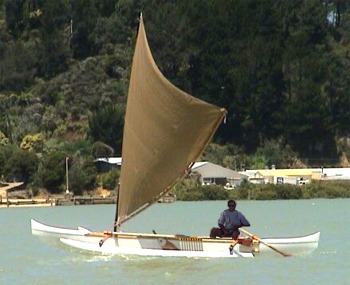
• You can really sail a va'a, with a small, inexpensive rig, because it has high stability and low resistance.
There are a few more basics on this page: Pacific outrigger canoes
What about sailing?
If you want a sailing rig it's cheap and easy to make one.
The traditional 'crabclaw' sailing rig has simple components but it is efficient.
This rig has a short, unstayed mast; a boom which doesn't need to be particularly stiff; a flat-cut sail with no battens; and low rig tension. Add a daggerboard to grip the water when sailing to windward and it will outperform a high-tech European sail of the same area, except on a close reach (something to do with vortex lift...). You don't really need sailcloth, carbon fibre and Dyneema for this one.
These are very easily-driven boats, it's fairly windy around here, and when you go much over 5 knots you start having spray come aboard, so the rig could be 30% smaller than the one in the photo.
Who uses them?
They're massively popular in the Pacific, and fairly popular in France and Italy, but have only just arrived in Britain. There is now a Royal Outrigger Canoe Club by the River Thames at Teddington ... not exactly the environment they were designed for.
In Europe, fishing-surfing va'a started to become quite popular about 15 years ago, with several manufacturers in France and Italy and a lot of home-builders in Germany. Also, a lot of kayak manufacturers have added sprint va'a to their ranges, but the sprint boats aren't really suitable for water temperatures and sea conditions in this part of the world.
Most 16-19 foot va'a are privately owned. Most of the 20-25 foot va'a are owned by canoe clubs, and you can see them in Brittany and Normandy as well as in the Med. Most of the really big ones are owned either by a canoe guiding and rental company, or by a beachfront hotel.
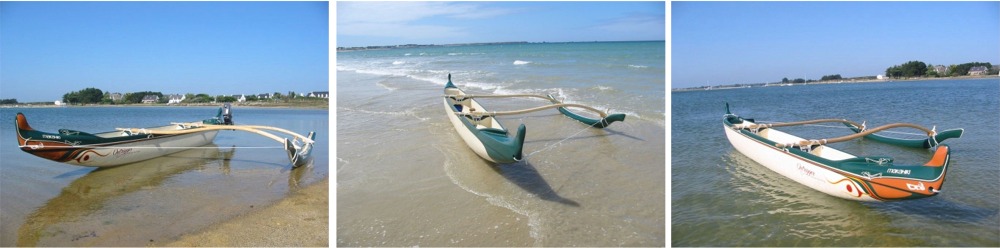
What does a small Hawaiian outrigger canoe look like?
It looks something like this Opae model from Kailua Kanu:
or this Makahiki model from JC "Doudou" Bosson / DDB Strat:
The plan:
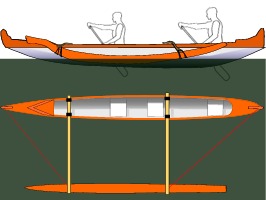
I'll build a strip-plank prototype of a 19-foot paddling va'a, sheathe it with fibreglass, put it by Tobermory harbour, and invite people to take it out and see what they think - starting with the Isle of Mull Kayak Group, which now has nearly 300 members.
And then try the same experiment at Ulva Ferry and Bendoran, if possible.
And if people like the design as much as I think they will, and feel that it suits local conditions, I'll take the prototype off the water, do a lot of filling, fairing and polishing to turn it into a fibreglass "plug", take a mould off it, and make some in GRP.
Are there commercial possibilities? There could be, I think, although you'd probably go broke making them in fibreglass. Rotomoulding in polyethylene might be a real commercial proposition, as with plastic kayaks and Pioner tenders. It's expensive to get going, because you need a mould milled out of solid aluminium, and a means of rotating the mould, while rocking it end-for-end. You also need a gas or infrared oven big enough to heat it to 280°C. I think the island, or at least Argyll & Bute, ought to have the ability to do rotomoulding so as to make things like pontoon floats, septic tanks, oil tanks, etc, where most of the cost is packaging, shipping, distribution and storage. (Pioner boats come from Norway...) Something to think about, down the line.
And finally, some of the big ones
These are 30-footer OC3 sailing and paddling canoes from Holopuni Canoes. Apart from the three crew, they can carry four passengers on the haka 'trampolines' stretched between the outrigger arms.
| Explore the Kayarchy website: • Sea Kayaking Intro • Kayaks & Equipment • Kayaking Technique • Sea & Weather • Full Contents |